
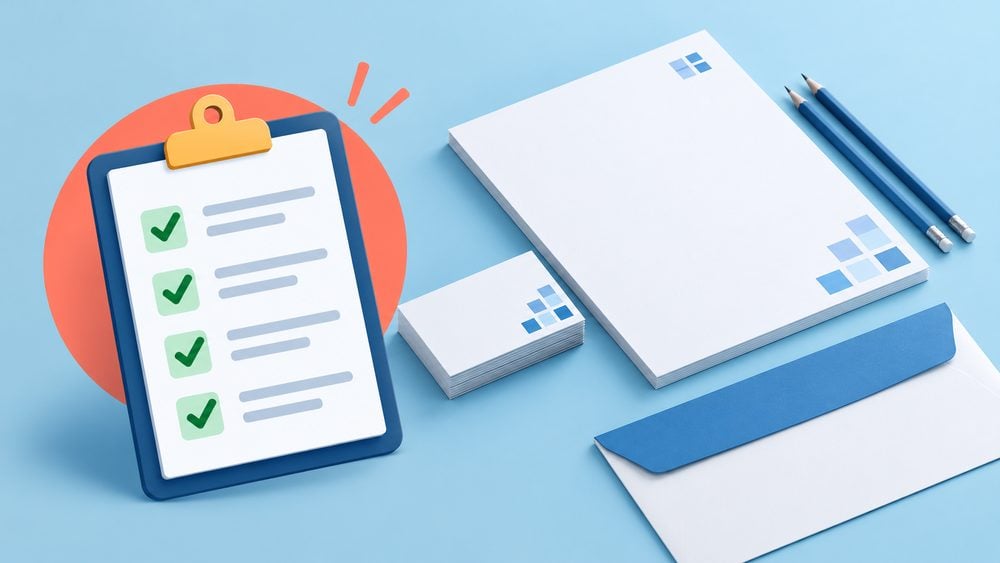
Business stationery might seem like a small detail, but it plays an important part in how customers see your business. Whether you’re meeting a potential client, sending a quotation or welcoming a new customer, professionally printed stationery helps create a consistent and recognisable brand.
From business cards and letterheads to compliment slips and presentation folders, choosing the right stationery ensures your business is prepared for everyday communication.
However, you don’t need to order every stationery product available. The key is understanding what your business actually needs, choosing suitable materials and checking your artwork before it goes to print.
This business stationery printing checklist covers the essential products worth considering, what to include in each design and the important printing checks that can help you avoid costly mistakes.
Even with emails, websites and digital marketing, printed stationery remains useful for many UK businesses.
Think about handing someone a business card after a meeting or presenting a quotation inside a branded folder. These small details can help make your business appear organised, professional and attentive.
Well-designed business stationery can help you:
Create a professional impression: Present your business consistently when communicating with customers.
Improve brand recognition: Use the same logo, colours and visual identity across different printed materials.
Make communication easier: Keep important contact details readily available.
Build customer relationships: Add personal touches to orders, correspondence and appointments.
Support everyday business activities: Have suitable materials ready for meetings, quotations, deliveries and customer visits.
The best stationery isn’t necessarily the most expensive. It’s stationery that looks professional, provides useful information and suits the way your business operates.
Before placing an order, consider how frequently you’ll use each product. Some businesses might need hundreds of business cards, while others may benefit more from letterheads or appointment cards.
Here are five stationery products to consider when putting together your business printing checklist.
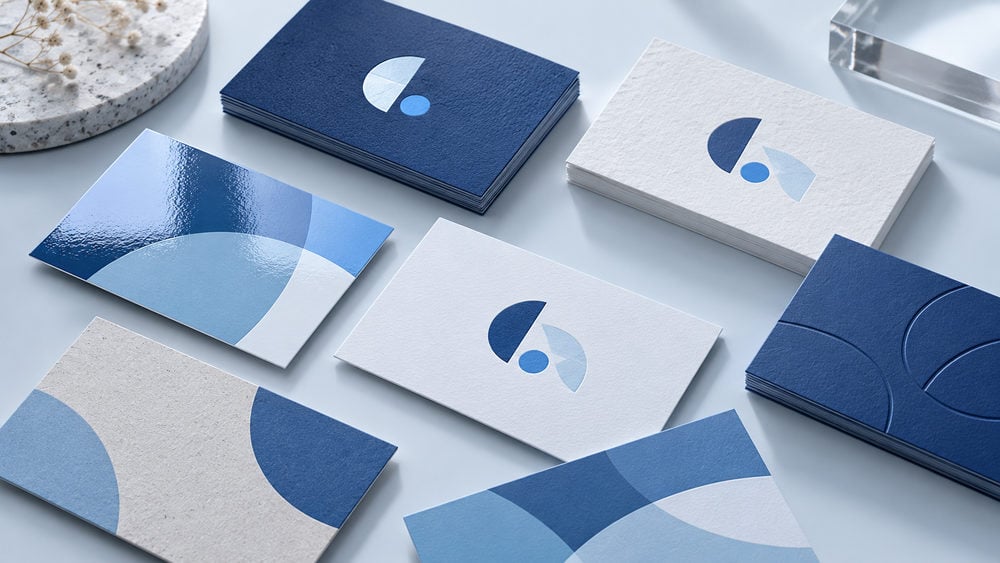
Business cards are one of the most practical pieces of printed stationery for networking and face-to-face communication.
They provide a convenient way to share your contact details with potential customers, suppliers and business contacts without relying on someone saving your information immediately.
A good business card should be easy to read, professionally designed and consistent with your brand.
Business card printing checklist:
Display your business name and logo clearly.
Include your name and job title, where appropriate.
Add your telephone number, email address and website.
Use readable fonts and consistent brand colours.
Choose suitable card thickness and finish.
Check all contact information before printing.
What paper should you choose?
For everyday business cards, 350gsm or 400gsm card can provide a sturdy, professional feel, depending on the options offered by your printer.
Matt finishes work well for understated designs, while gloss finishes can make colourful artwork appear more vibrant. Uncoated cards may be preferable if you want to write notes on them.
You can also consider double-sided printing to give your design more space without overcrowding the front.
Our recommendation: Keep the design simple. Your business name, logo and contact details should be easy to find at a glance.
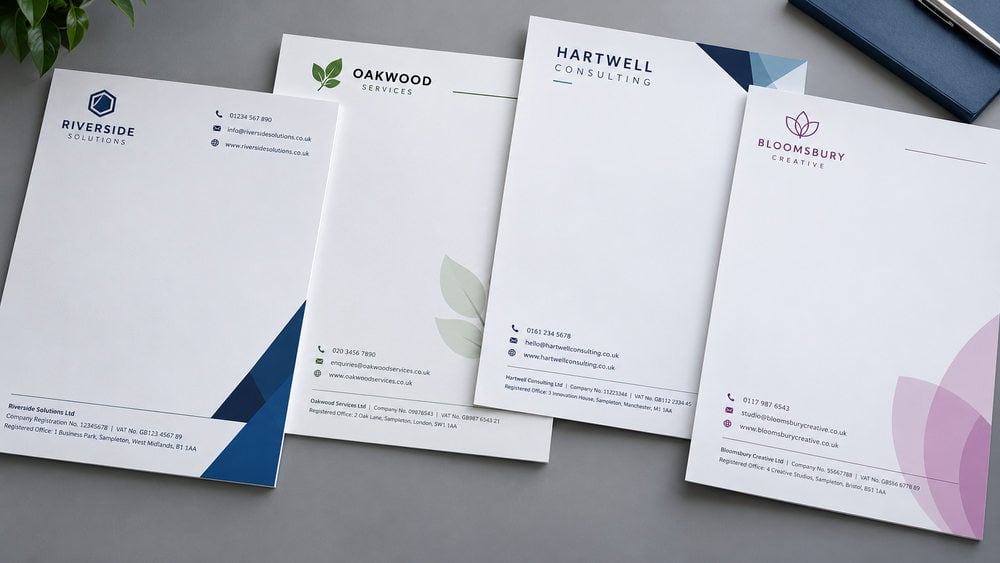
Printed letterheads provide a consistent format for formal business correspondence.
They are particularly useful for companies that regularly send quotations, covering letters, customer communications and other printed documents.
A professional letterhead normally includes your logo and business details, leaving sufficient space for the main message.
Letterhead printing checklist:
Position your business logo and name prominently.
Include relevant contact information.
Add the required company registration details, where applicable.
Leave enough clear space for letters and documents.
Ensure your design works with office printers.
Check that text remains readable when printed.
What size and paper should you choose?
A4 is a practical choice for standard business correspondence because it works with most office printers and document folders.
For paper, 100gsm or 120gsm uncoated stock can provide a good balance between quality and everyday usability. If you regularly print additional text onto your letterheads, check that your chosen paper is compatible with your printer.
Important for UK limited companies: Business letters must include certain registered company details. Check the applicable requirements before approving your artwork.
Our recommendation: Avoid placing large graphics behind the main writing area. A clean layout is generally easier to read and more economical for everyday document printing.
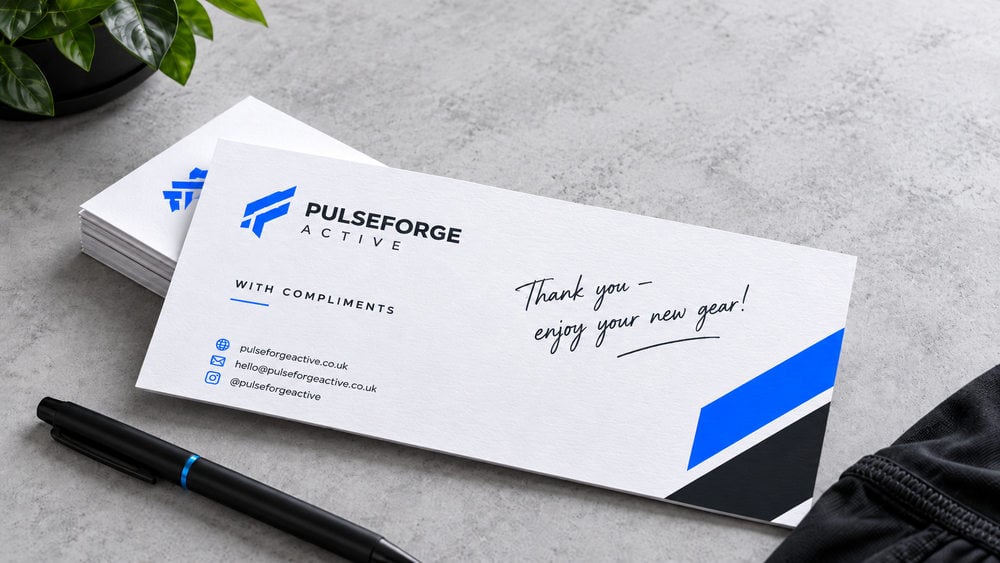
Compliment slips are small pieces of branded stationery used to accompany documents, parcels, product samples and customer orders.
They’re particularly useful when you want to include a short handwritten message without preparing a formal letter.
For example, an online retailer might add a thank-you note to a customer order, while a professional services company could include a compliment slip with documents being returned to a client.
Compliment slip printing checklist:
Include your business logo and contact details.
Leave enough space for a handwritten message.
Use paper that is easy to write on.
Keep the design consistent with your letterheads.
Choose a quantity that reflects how often you’ll use them.
What size should you choose?
A standard DL compliment slip measures 99 × 210mm. This compact format fits neatly inside common business envelopes and alongside A4 correspondence.
Uncoated paper is often a good choice because it is suitable for writing short personal messages.
You could include a simple printed message such as ‘With compliments’ or ‘Thank you for your order’, leaving room to personalise it.
Our recommendation: Use compliment slips to make customer communication feel more personal rather than treating them as another advertising leaflet.
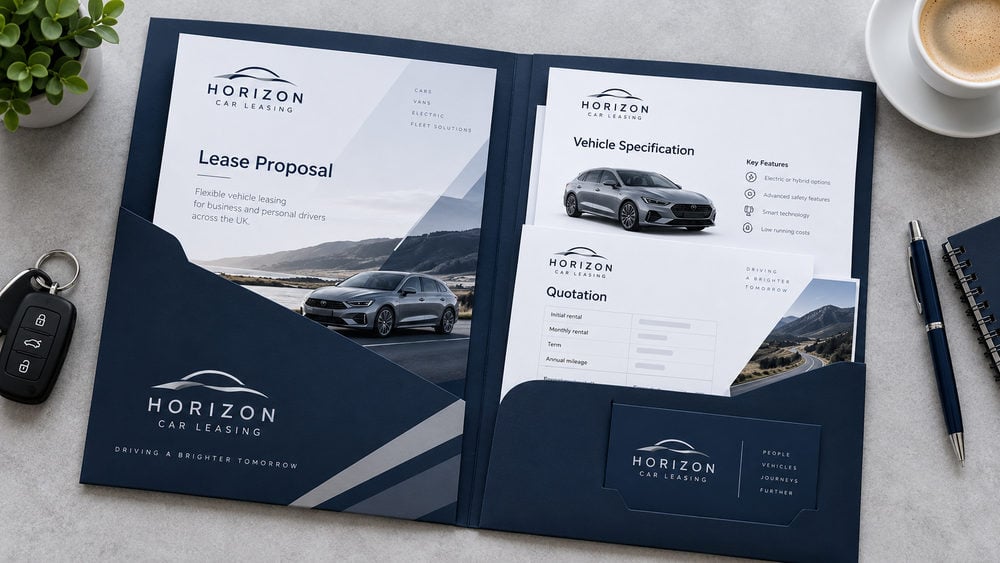
Presentation folders help businesses keep printed documents together while presenting them in a professional way.
They’re useful for sales meetings, proposals, conferences, property information packs and client welcome documents.
Rather than handing over several loose sheets of paper, a branded folder keeps everything organised and makes it easier for the recipient to refer back to your information.
Presentation folder printing checklist:
Choose a folder size suitable for your documents.
Include your business logo and brand colours.
Decide whether you need one or two document pockets.
Consider whether business card slots would be useful.
Choose suitable card thickness and finishing options.
Check that your documents fit comfortably inside.
Which presentation folder should you choose?
A4 presentation folders are suitable for standard reports, quotations and sales documents. A5 folders may be a better fit for smaller brochures and information packs.
Depending on your requirements, you can choose between interlocking and glued pocket styles.
You may also want to consider matt or gloss lamination for added protection and a more finished appearance.
Our recommendation: If you regularly attend sales meetings or distribute proposals, a professionally printed presentation folder can be a worthwhile addition to your stationery collection.
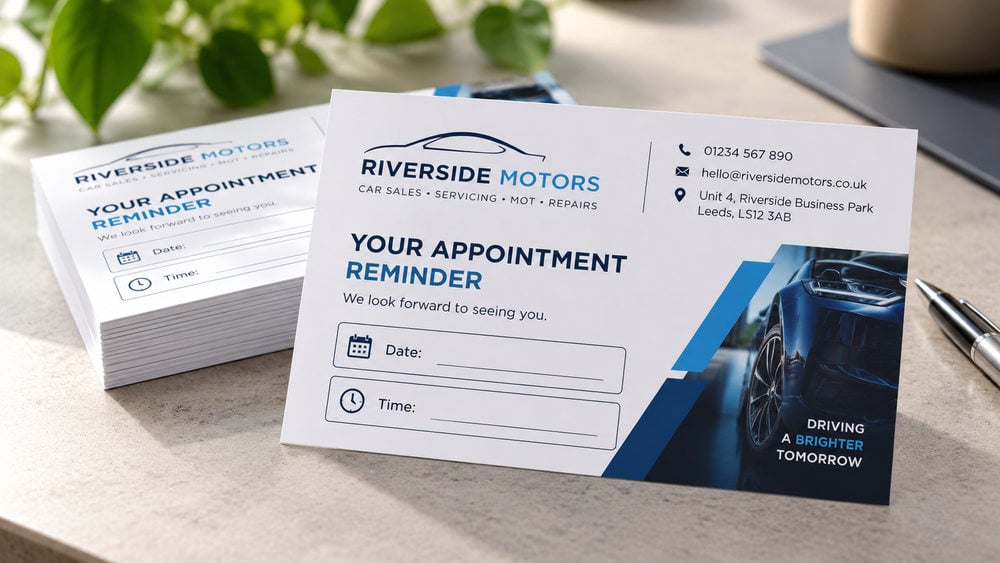
Appointment cards are especially useful for businesses that arrange regular customer visits.
Hairdressers, beauty salons, clinics, garages and other appointment-based services can use them to provide customers with a physical reminder of their next booking.
Although digital reminders are widely used, printed appointment cards can still offer a convenient alternative or extra reminder.
Appointment card printing checklist:
Include your business name and logo.
Provide enough space to write the appointment date and time.
Display your contact number or booking details.
Use readable fonts and a clear layout.
Choose a surface suitable for writing.
Consider double-sided printing.
What design works best?
A compact card that fits into a wallet or purse is often convenient.
One side could display your business branding and contact information, while the reverse provides space for appointment details.
If your staff need to write dates and times by hand, avoid using a glossy coating over the writing area.
Our recommendation: Keep the appointment section simple and easy to complete. The main purpose is to help customers find their booking information quickly.
You don’t necessarily need all five products from the beginning. Your priorities will depend on the type of business you run and how you communicate with customers.
Use the table below as a starting point.
| Business type | Recommended stationery |
|---|---|
| Freelancers and consultants | Business cards, letterheads |
| Small offices and professional services | Letterheads, business cards, presentation folders |
| Online shops and retailers | Compliment slips, business cards |
| Beauty salons and appointment-based businesses | Appointment cards, business cards |
| Sales teams and estate agents | Business cards, presentation folders, letterheads |
| New businesses | Business cards and letterheads to begin with |
If you’re working with a limited printing budget, start with the products you’ll use most frequently.
For example, if most of your customer interactions happen online, you may get more use from branded compliment slips included with orders than from expensive presentation folders.
Choosing your stationery is only half the process. Before placing an order, it’s important to check that your designs are suitable for professional printing.
Small artwork mistakes can affect the final appearance of your stationery and may require files to be corrected before production.
Always set up your artwork to the correct finished size.
For example, an A4 letterhead should have a finished size of 210 × 297mm, while a DL compliment slip is normally 99 × 210mm.
Different stationery products may have specific templates, so check your printer’s requirements before starting your design.
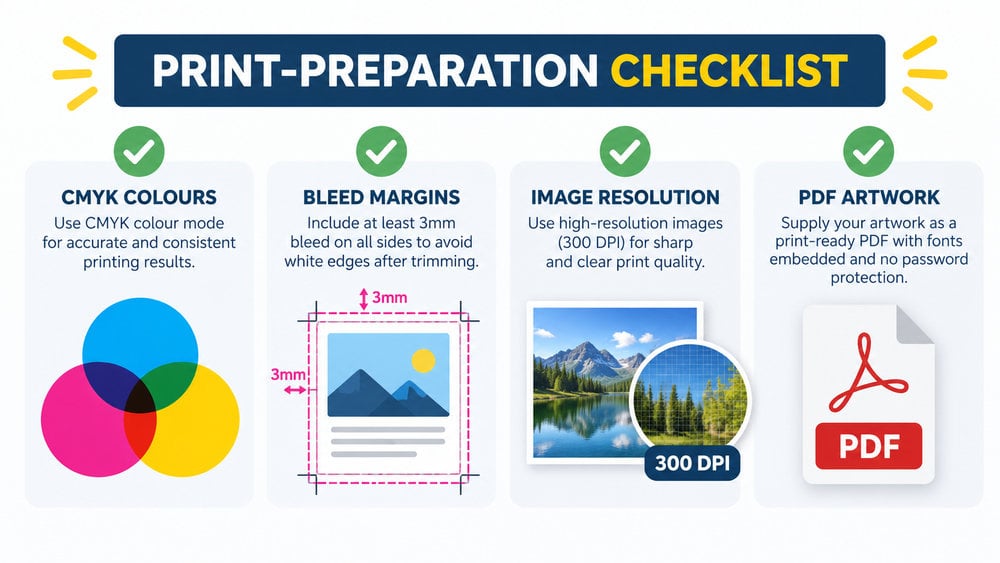
Bleed is the extra printed area extending beyond the final cutting edge. It helps prevent unwanted white borders when artwork is trimmed.
Many commercial printers request 3mm bleed on each edge, although requirements can vary.
Keep important information, such as telephone numbers and logos, within the recommended safe margin so it isn’t accidentally trimmed.
Professional printing commonly uses CMYK colour, which stands for cyan, magenta, yellow and black.
Digital screens use RGB colour, so some colours may look different when printed.
Where requested by your printer, prepare your artwork using the appropriate CMYK colour profile.
Images that look clear on a phone or laptop may become blurry when printed.
For small printed stationery, images are generally best supplied at around 300dpi at their intended print size.
Make sure logos and graphics are high enough quality for your chosen product. Vector artwork is particularly useful for logos because it can be resized without losing sharpness.
Before approving your artwork, carefully check:
Business names and spelling
Telephone numbers and email addresses
Website addresses
Company registration details, where required
Logo placement and brand colours
Font sizes and text alignment
It’s worth asking another person to proofread your design. Familiar information can be surprisingly easy to overlook.
A print-ready PDF is commonly preferred for professional printing.
Check that fonts are embedded or outlined where required, images are suitable for print and bleed settings are included.
Always follow the artwork specifications provided for your chosen stationery product.
Even well-designed stationery can disappoint if a few important details are overlooked.
A few minutes spent reviewing your designs can save time, money and frustration later.
Professional stationery doesn’t have to put unnecessary pressure on your budget.
One of the simplest ways to control costs is to plan your printing requirements before ordering. Consider these practical tips:
Rather than automatically choosing the lowest price, compare paper quality, finishing options, quantities and delivery costs to understand the overall value.
Most small businesses can start with business cards and letterheads, depending on how they communicate with customers. Compliment slips, presentation folders and appointment cards are useful additions for businesses that regularly send orders, attend meetings or arrange customer bookings.
Business cards are useful for networking and sharing contact details, while letterheads are valuable for formal written communication. The most important product is whichever your business uses most frequently.
It depends on the product. Business cards often use thick card stock, while letterheads and compliment slips are commonly printed on uncoated paper suitable for writing or office printing. Always check the available paper options and their intended use.
Yes. Using consistent logos, colours, fonts and layouts across your stationery helps customers recognise your business and gives your printed materials a more coordinated appearance.
Business stationery is primarily used for everyday communication and administration, such as business cards, letterheads and compliment slips. Marketing materials, such as flyers and brochures, are generally designed to promote products, services or special offers. Some printed products can serve both purposes.
Start with the correct finished dimensions, add the required bleed, use suitable image resolution and check your colour settings. Proofread all details and supply your artwork in the format requested by your printer, usually a print-ready PDF.
The right business stationery can make everyday communication easier while helping your company maintain a professional appearance.
Whether you’re setting up a new business or updating your existing branding, focus on the stationery you’ll actually use, choose suitable materials and take time to prepare your artwork correctly.
At Cheap as Prints, we offer a range of personalised business stationery printing options, including business cards, letterheads, compliment slips and presentation folders.
Explore our business stationery printing range to compare products and find suitable options for your business.
Need help choosing your stationery? Contact Cheap as Prints on 01922 666 288 to discuss your printing requirements.
We use cookies to enhance your experience. By continuing, you agree to our Privacy Policy.
Select which cookies you want to allow:
Save 5% on your order when you subsribe to our newsletter.
