
Choosing the right paper size is an important part of any printing project. Whether you’re printing business documents, promotional flyers, leaflets or large posters, understanding UK paper sizes helps you choose the best format for your needs.
In the UK, most printing follows the international A-series paper size system, which includes familiar formats such as A4, A5 and A3. But what are their exact dimensions, and which size should you choose?
This guide explains the most common paper sizes in the UK, with a handy size chart showing dimensions in millimetres (mm), centimetres (cm) and inches. We’ll also look at how each size is used, how paper sizes compare and what to consider when preparing artwork for printing.
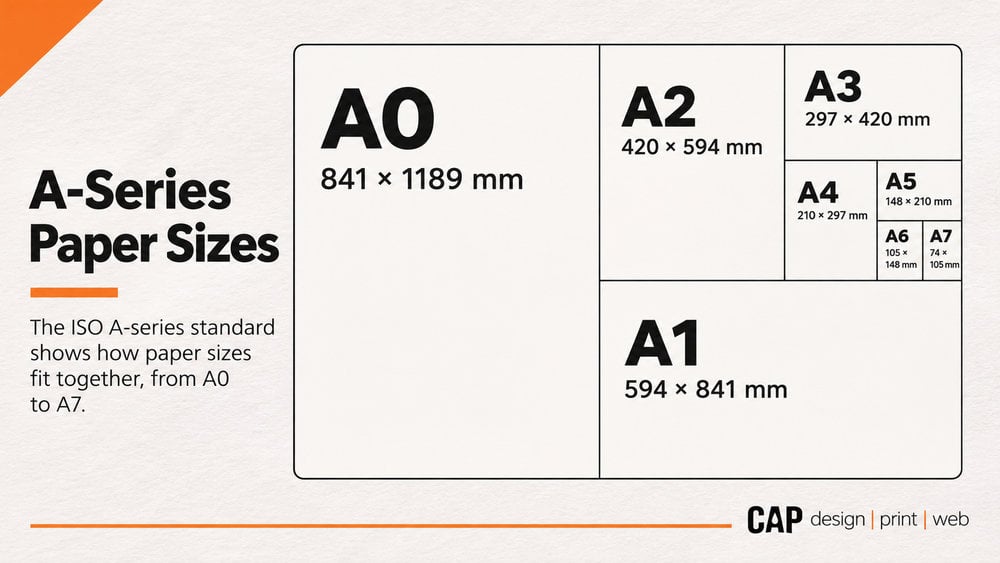
The UK mainly uses the A-series paper sizes, defined by the international ISO 216 standard.
A4 is the standard size for everyday documents, while larger formats such as A3, A2, A1 and A0 are commonly used for posters, displays and technical drawings. Smaller sizes, including A5, A6 and A7, are popular for flyers, invitations and promotional materials.
The system follows a straightforward rule: each paper size is approximately half the area of the previous larger size.
For example:
A3 is twice the size of A4.
A4 is twice the size of A5.
A5 is twice the size of A6.
A6 is twice the size of A7.
This makes it easy to scale designs up or down without changing their proportions.
If you’re looking for a quick paper size reference, the following chart shows the standard UK A-series dimensions.
| Paper size | Millimetres (mm) | Centimetres (cm) | Inches (approx.) |
|---|---|---|---|
| A0 | 841 × 1189 | 84.1 × 118.9 | 33.1 × 46.8 |
| A1 | 594 × 841 | 59.4 × 84.1 | 23.4 × 33.1 |
| A2 | 420 × 594 | 42 × 59.4 | 16.5 × 23.4 |
| A3 | 297 × 420 | 29.7 × 42 | 11.7 × 16.5 |
| A4 | 210 × 297 | 21 × 29.7 | 8.3 × 11.7 |
| A5 | 148 × 210 | 14.8 × 21 | 5.8 × 8.3 |
| A6 | 105 × 148 | 10.5 × 14.8 | 4.1 × 5.8 |
| A7 | 74 × 105 | 7.4 × 10.5 | 2.9 × 4.1 |
Measurements are shown with the shorter edge first, as they would appear in portrait orientation. The dimensions are the same in landscape orientation, with the edges reversed. The lower the A number, the larger the sheet. A0 is the largest size in this chart, while A7 is the smallest.
Each paper size has its advantages. The best choice depends on how much information you need to include, how your printed material will be displayed and how your audience will use it.
Let’s look at the most common UK printing sizes from the smallest to the largest.
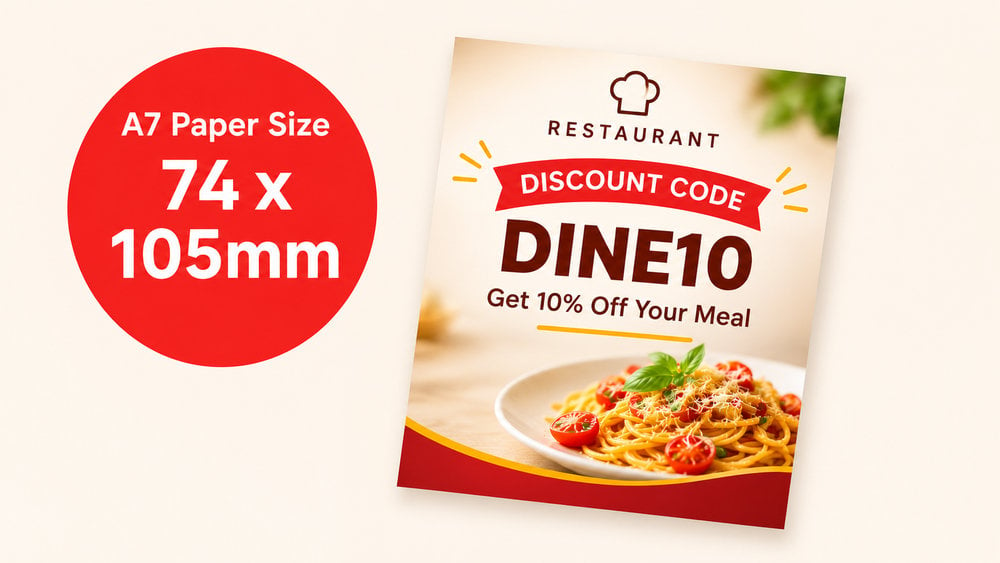
A7 is a small paper format measuring 74 × 105 mm. Although compact, it’s useful for printed materials that need to be handed out, included in packaging or carried easily.
Common uses of A7 paper:
Small promotional cards
Discount vouchers
Loyalty cards and coupons
Product information inserts
Small invitation cards
Compact notes and reminders
A7 is best suited to short messages and simple designs. For example, a retailer could include an A7 discount card inside a customer’s order, encouraging them to make another purchase. With limited printing space, a clear headline, short message and simple design usually work best.
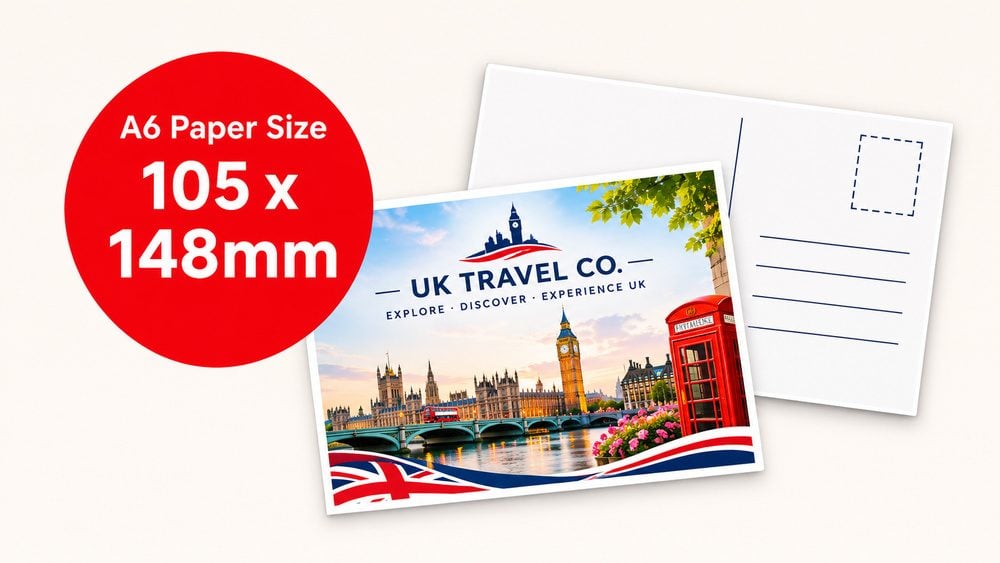
A6 is a compact format measuring 105 × 148 mm. It’s a quarter of the area of A4 and half the area of A5. This smaller size works well when you want to share a short message without including too much text.
Common uses of A6 paper:
Small promotional flyers
Event invitations
Appointment reminder cards
Discount vouchers
Thank-you cards and promotional inserts
A6 is particularly effective for simple designs with eye-catching graphics, a brief offer and clear contact details. For example, a local business advertising a special offer could use an A6 flyer with a bold headline, relevant image and QR code. Because space is limited, keep the design uncluttered and make the most important information easy to read.
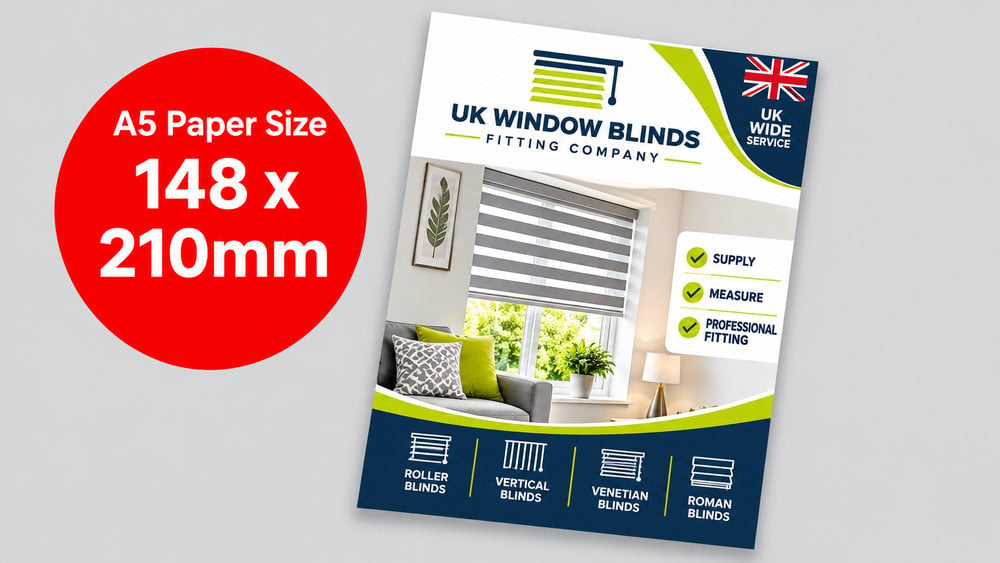
A5 is half the size of A4 and is one of the most popular formats for promotional printing. Measuring 148 × 210 mm, A5 offers a useful balance between portability and space for information.
Common uses of A5 paper:
Small booklets and brochures
Event programmes
Invitations and greetings cards
Takeaway menus
Notepads and information handouts
A5 is particularly useful for businesses distributing printed marketing materials at events, through local promotions or directly to customers. It’s large enough for an attractive design, a short message and a clear call to action, without feeling bulky. If you need an affordable, easy-to-distribute format for marketing, A5 is often a sensible starting point.
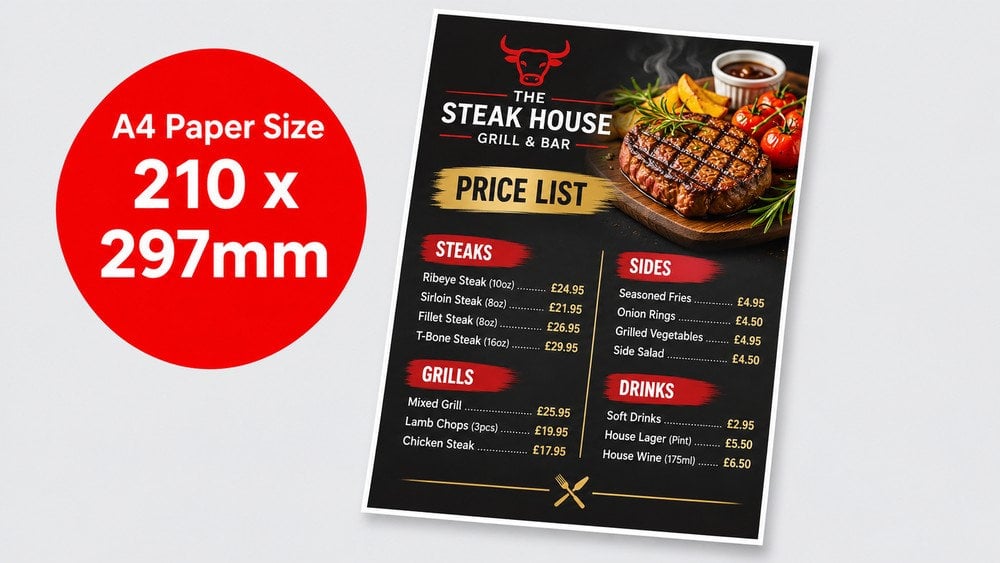
A4 is the most familiar paper size in the UK. It’s the standard format used by most office and home printers, making it a practical choice for everyday printing. At 210 × 297 mm, A4 offers enough space for detailed information while remaining convenient to store, distribute and handle.
Common uses of A4 paper:
Business letters, letterheads and invoices
Reports, forms and official documents
Brochures and information sheets
Restaurant menus and price lists
School worksheets and educational materials
A4 is a good choice when you have a reasonable amount of information to communicate without needing a large printed format. For business promotions, A4 flyers and leaflets can provide plenty of space for product details, photographs and contact information.
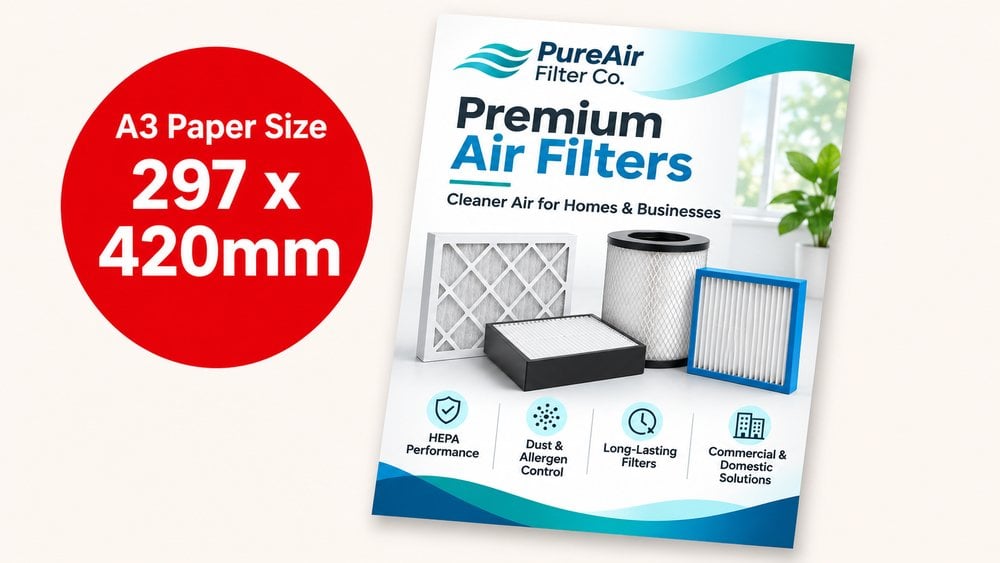
A3 measures 297 × 420 mm, making it twice the size of A4. It’s a useful option when you need more room for images, diagrams or information that people should be able to read from a short distance.
Common uses of A3 paper:
Restaurant menus
Wall calendars and planners
Educational charts
Product displays
Technical drawings and presentations
A3 is popular for indoor promotions, especially where an A4 sheet would be too small. For example, an A3 poster can work well in a café window, reception area or community noticeboard. It’s a practical choice for businesses wanting to attract attention without using an oversized display
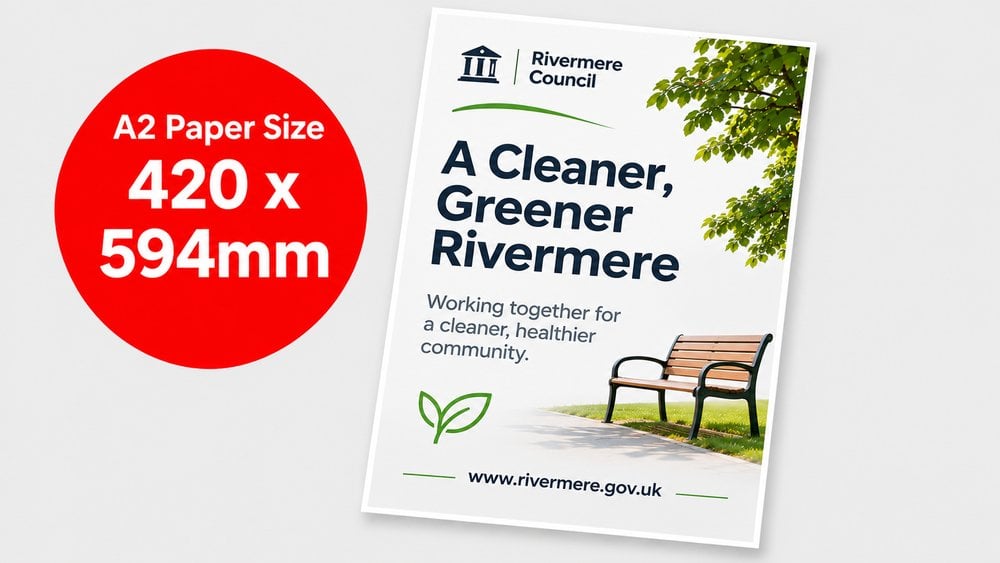
A2 paper measures 420 × 594 mm, offering twice the area of A3. It’s commonly used for printed materials designed to be noticed from further away.
Common uses of A2 paper:
Event announcements
Retail promotions
Photography and art prints
Exhibition graphics
Large charts and diagrams
A2 provides enough space for striking visuals, bold headings and supporting information. It can be particularly effective in shop windows, waiting areas, exhibition spaces and other indoor locations where people need to notice information quickly.
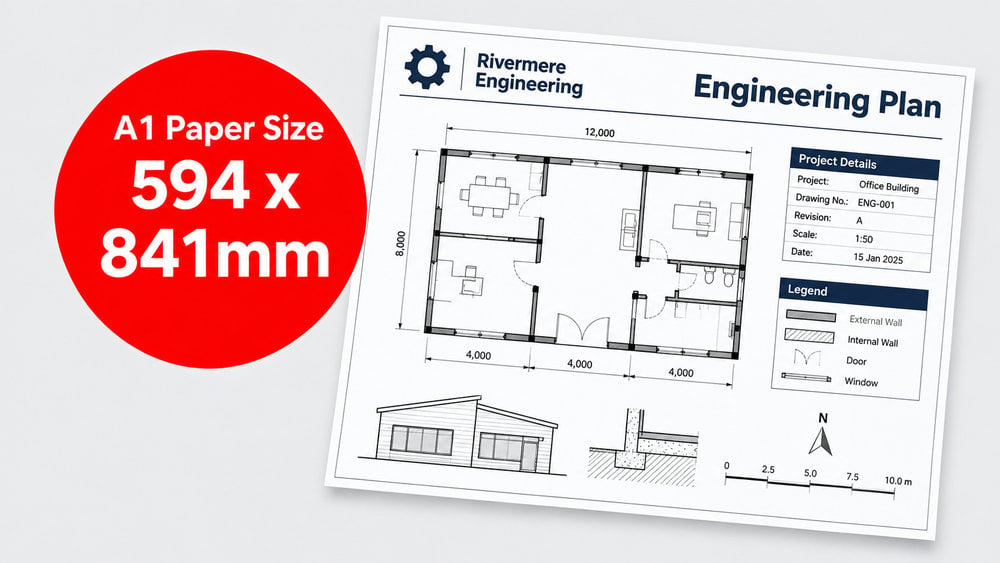
A1 is a large paper format measuring 594 × 841 mm. It’s twice the area of A2 and is commonly chosen when a message needs to stand out.
Common uses of A1 paper:
Shop-window promotions
Exhibition displays
Architectural drawings
Engineering plans
Large artwork and photographic prints
A1 gives designers plenty of space to work with, making it suitable for bold promotional graphics and detailed technical drawings. If your poster needs to be visible across a room or from a reasonable viewing distance, A1 may be more suitable than A2 or A3. However, it’s still important to keep the main message clear rather than filling the extra space with unnecessary text.
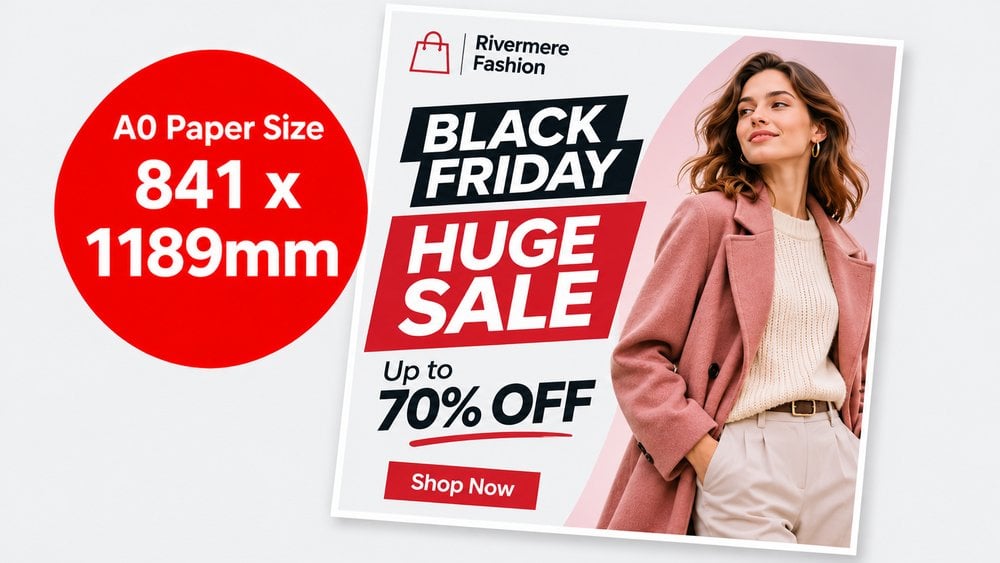
A0 is the largest A-series size covered in this guide, measuring 841 × 1189 mm. An A0 sheet has an area of approximately one square metre, making it suitable for large-format printing projects.
Common uses of A0 paper:
Architectural plans
Engineering and construction drawings
Educational displays
Detailed maps
Large-format art prints
A0 provides generous space for detailed information, technical illustrations and eye-catching graphics. It’s particularly useful when printed material needs to remain readable at a larger scale. Because of its size, A0 printing may require specialist large-format printing equipment and suitable display space.
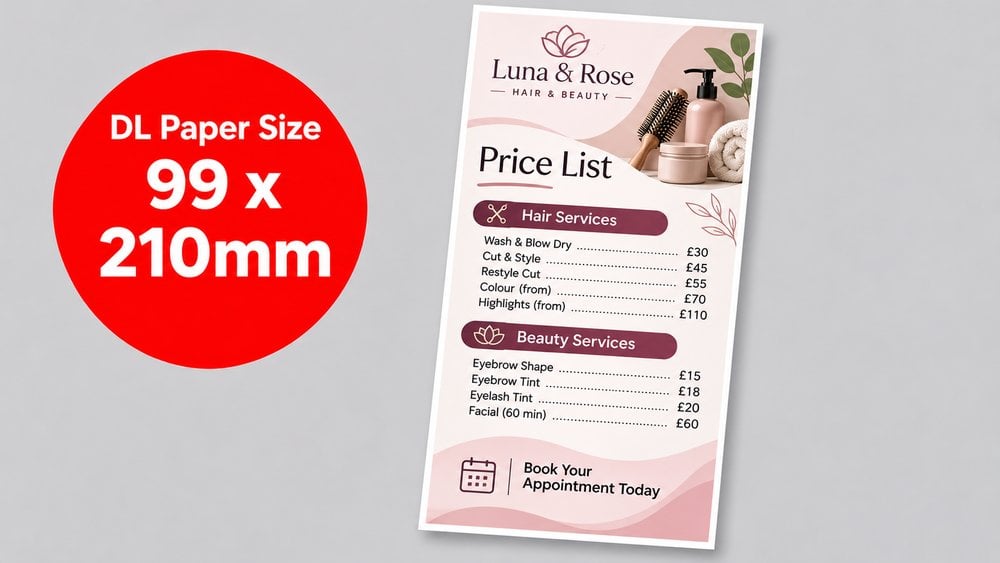
As well as standard A-series paper sizes, you may come across DL when ordering leaflets, flyers or envelopes. For commercial printing, a common DL leaflet measures 99 × 210 mm, which is one-third of an A4 sheet.
This long, narrow format is particularly popular for:
Takeaway menus
Price lists
Travel and tourism information
Folded brochures
Direct-mail marketing
DL leaflets are useful when you want a compact format that can contain several short sections of information. An A4 sheet folded into three equal sections creates panels of approximately 99 × 210 mm, making it suitable for a six-panel promotional leaflet. It’s worth noting that a DL envelope measures 110 × 220 mm, so it’s larger than a one-third A4 leaflet.
Although A-series paper is the most common choice in the UK, two other size systems are useful to understand.
B-series paper sizes sit between the corresponding A-series sizes and the next larger A size. For example, B5 measures 176 × 250 mm, making it larger than A5 but smaller than A4.
B-series formats are sometimes used for books, notebooks, speciality printing and posters. They are less common than A-series sizes for everyday business printing.
C-series sizes are mainly used for envelopes. They’re designed to accommodate corresponding A-series sheets.
| Envelope size | Dimensions | What fits inside |
|---|---|---|
| C4 | 229 × 324 mm | A4 paper without folding |
| C5 | 162 × 229 mm | A5 paper or A4 folded once |
| C6 | 114 × 162 mm | A6 paper or A4 folded twice |
| DL | 110 × 220 mm | A4 paper folded into thirds |
If you’re ordering business stationery, choosing the right envelope size is just as important as selecting the paper itself. For example, a C4 envelope is ideal for sending an A4 document flat, while a DL envelope is suitable for a standard business letter folded into thirds. You can explore printed envelopes if you need matching branded stationery.
Choosing the right size isn’t simply about finding the biggest or smallest option. Think about the purpose of your printed material and how people will use it.
Here’s a quick guide to choosing a format.
| Printing project | Suggested size | Why choose it? |
|---|---|---|
| Business documents | A4 | Standard and convenient for everyday use |
| Promotional flyers | A5 or A6 | Easy to distribute and suitable for concise messages |
| Postcards and invitations | A6 | Compact and easy to handle |
| Folded marketing leaflets | A4 folded to DL panels | Suitable for organising information into sections |
| Restaurant menus | A4 or A3 | Offers space for menu items and prices |
| Small promotional posters | A3 | Works well on noticeboards and in smaller displays |
| Shop-window posters | A2 or A1 | More visible from a distance |
| Large technical plans | A1 or A0 | Provides space for detailed drawings |
| Small promotional inserts | A7 | Convenient for packaging and short messages |
When deciding between two sizes, consider three things: the amount of content, the viewing distance and your budget.
A smaller leaflet may be sufficient for a short promotion, but a larger format can be more effective when you need to display detailed information or attract attention.
The ideal size makes your content easy to read without adding unnecessary printing costs.
Selecting the correct paper dimensions is only one part of preparing a successful print job.
Before sending your artwork to print, it’s worth checking a few important details.
Your design should match the finished size of the printed product. For example, an A5 flyer should be designed at 148 × 210 mm before any required bleed is added. Using the wrong dimensions may result in unexpected cropping or unwanted white borders.
Bleed is extra artwork that extends beyond the finished cutting edge. On most occasions approximately 3 mm of bleed on each side is sufficient although requirements can vary. For example, an A4 design with 3 mm bleed on all four sides would have an overall artwork size of 216 × 303 mm. Keep important text and logos safely inside the cutting edge so they aren’t accidentally trimmed. Always check your printing artwork specifications before submitting a file.
Low-resolution images can appear blurry or pixelated when printed, especially at larger sizes. For most standard-sized printed materials, images at approximately 300 dpi at their intended print dimensions are a useful starting point. Large-format posters may have different resolution requirements depending on their size and intended viewing distance.
Paper size and paper weight are different things. Paper size refers to the sheet’s dimensions, while paper weight is commonly measured in grams per square metre (gsm). For example, an A5 flyer could be printed on lightweight paper or a thicker card stock, depending on the finish you want. The right combination of size, paper stock and finish can make a noticeable difference to the final product.
Before placing an order, check that your design has the correct dimensions, readable text, appropriate image quality and any required bleed. A print-ready PDF is often a suitable file format, but always follow your printer’s specific requirements.
A4 is the standard paper size used for most everyday documents in the UK. It measures 210 × 297 mm and is commonly used for letters, reports, forms and office printing.
Yes. A3 measures 297 × 420 mm, giving it approximately twice the area of A4. It’s commonly used for posters, charts, menus and larger documents.
Yes. A5 measures 148 × 210 mm and has approximately half the area of A4. It’s a popular choice for promotional flyers, booklets and small brochures.
A5 and A6 are popular flyer sizes because they’re compact, easy to distribute and suitable for promotional messages.
A4 offers more room for detailed information, while DL is useful for slim leaflets and folded marketing materials.
The best option depends on your content, design and method of distribution.
A3 is suitable for smaller posters and notices, while A2 and A1 are good options for larger promotional displays.
A0 is useful for oversized posters, detailed plans and other large-format prints.
Choose a size that suits your display space and the distance from which people need to read it.
An A0 sheet has approximately the same area as 16 A4 sheets. The A-series system is designed so each successive size is half the area of the previous one, allowing for standardised scaling and folding.
Understanding UK paper sizes makes planning a printing project much easier. From everyday A4 documents and compact A6 promotional cards to large A1 and A0 posters, each paper size serves a different purpose.
The key is to choose a format that suits your content, your audience and how your finished print will be used. If you’re still unsure which size works best, start by thinking about where the printed material will be displayed, how much information it needs to contain and whether people will be reading it up close or from a distance.
At Cheap as Prints, we offer a range of printing products for businesses, organisations and individuals across the UK. Explore our flyer and leaflet printing and poster printing options to find a suitable format for your next project.
Need help choosing the right paper size? Contact Cheap as Prints on 01922 666 288 or email info@cheapasprints.com for assistance with your printing requirements.
We use cookies to enhance your experience. By continuing, you agree to our Privacy Policy.
Select which cookies you want to allow:
Save 5% on your order when you subsribe to our newsletter.
