

Creating your own business cards doesn’t have to be difficult or expensive. If you already use Microsoft Word, you can design a professional-looking business card without needing specialist design software.
Whether you’re starting a new business, updating your contact details or preparing for a networking event, Microsoft Word gives you the tools to create a business card that reflects your brand.
There are two main ways to get started:
Use a business card template: The quickest and easiest option, particularly if you’re a beginner.
Create a business card from scratch: Ideal if you want greater control over the layout, colours and overall design.
Both methods allow you to personalise your business cards with your company name, contact details, branding and logo.
In this step-by-step guide, we’ll show you how to create business cards in Microsoft Word, using either a ready-made template or a blank document. We’ll also explain how to add your logo, choose the correct dimensions and save your design for professional printing.
If you’re new to designing business cards, using a Microsoft Word template is a great place to start. Templates come with a pre-designed layout, so you can concentrate on adding your business information rather than building everything from scratch.
Open Microsoft Word on your computer.
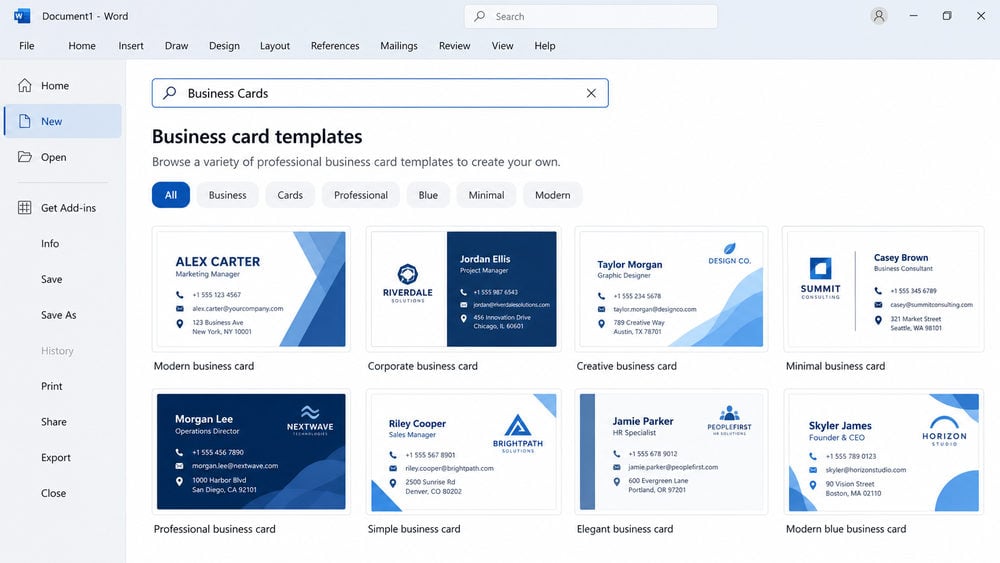
Click File > New.
Type Business Cards into the template search box.
Browse the available designs.
Select a template you like and click Create.
Word will open your chosen template in a new document, ready for editing.
If you can’t find a suitable design within Word, you can also explore Microsoft’s free business card templates.
Once your template is open, click on the sample text and replace it with your own information.
Most business cards include:
Your name and job title
Business or company name
Telephone number
Email address
Website address
Business logo
You can also include a business address, social media handle or QR code if it’s relevant to your customers.
Try not to overcrowd your business card. The aim is to make your contact details easy to find and read at a glance.
Now it’s time to make the template your own.
You can change the font, text size and colour using the Home tab. If the template contains editable shapes, you can also adjust their colours to match your branding.
To replace an existing logo, select the image and use the available picture options, or delete it and insert your own.
For the best results, keep your design consistent with your other business materials. Using the same logo, brand colours and fonts helps people recognise your business.
If your template displays several business cards on one page, check whether changing one card also updates the others. Some templates require you to edit each card separately.
Before saving, take a moment to review your business card.
Make sure your contact details are correct, your logo looks sharp and all the text is readable.
Also check that the design fits within the template boundaries and that nothing important sits too close to the edge.
Once you’re happy with the result, save your Word document so you can make changes later.
You can then export the finished design as a PDF for printing.
Prefer to create something completely your own? Microsoft Word also lets you design a business card using a blank document.
This method takes a little more time, but it gives you more freedom over the layout and appearance.
Start by opening a blank document in Microsoft Word.
Before adding any text or graphics, you’ll need to set the correct page size.
A standard UK business card measures 85mm × 55mm.
If you’re preparing your design for professional printing and your printer requires a 3mm bleed on every edge, the artwork size will be 91mm × 61mm.
Bleed is the extra area around your design that gets trimmed away during printing. It helps prevent unwanted white edges when colours or images extend to the edge of your business card.
To change the page dimensions:
Open a blank Word document.
Select the Layout tab.
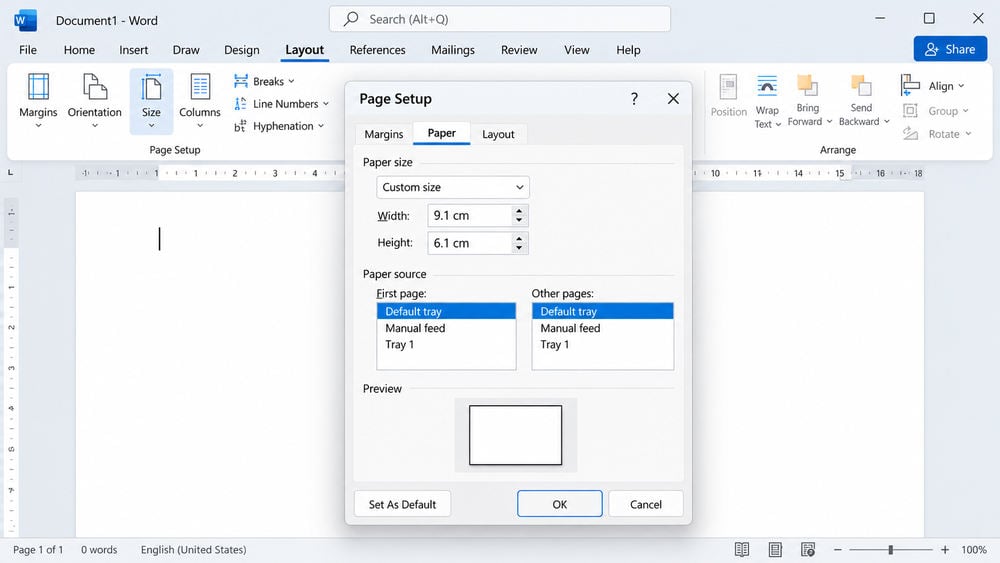
Click Size > More Paper Sizes.
Under the Paper tab, enter your chosen width and height.
Click OK to apply the dimensions.
For a business card with 3mm bleed, enter:
Width: 9.1cm
Height: 6.1cm
You may also need to adjust the page margins under Layout > Margins > Custom Margins to give yourself more room to work.
Remember that the finished card will still measure 85mm × 55mm. The additional 3mm around each edge is intended to be trimmed away.
Important: Before creating your artwork, check the size, bleed and file requirements of your chosen printing service. These can vary depending on the business card product.
With your page set up, you can start adding your business information.
Text boxes are particularly useful because they allow you to position text exactly where you want it.
To insert a text box:
Select Insert > Text Box.
Choose Draw Text Box.
Click and drag to create a text box on your page.
Enter your name, business details or contact information.
Use the Home tab to adjust the font, size, colour and alignment.
You can create separate text boxes for different details, making it easier to organise your design.
For example, you might place your name and job title on one side, with your contact details underneath or on the opposite side.
To remove an unwanted text box border, select the box and choose Shape Format > Shape Outline > No Outline.
Design tip: Use a clear, readable font and avoid making your text too small. Although business cards have limited space, customers should be able to read your details comfortably.
Your logo is one of the most recognisable parts of your branding, so it’s worth giving it a prominent position.
To add your logo in Microsoft Word:
Click Insert > Pictures > This Device.
Locate your logo on your computer.
Select the file and click Insert.
Resize the logo using the corner handles.
Use the picture layout options to position it on your business card.
For greater control over positioning, select your logo and explore the Wrap Text options under Picture Format.
Choose a suitable layout option, such as In Front of Text, if you need to move the logo freely.
Use a high-quality logo file wherever possible. Small or blurry images may look acceptable on screen but become more noticeable when printed.
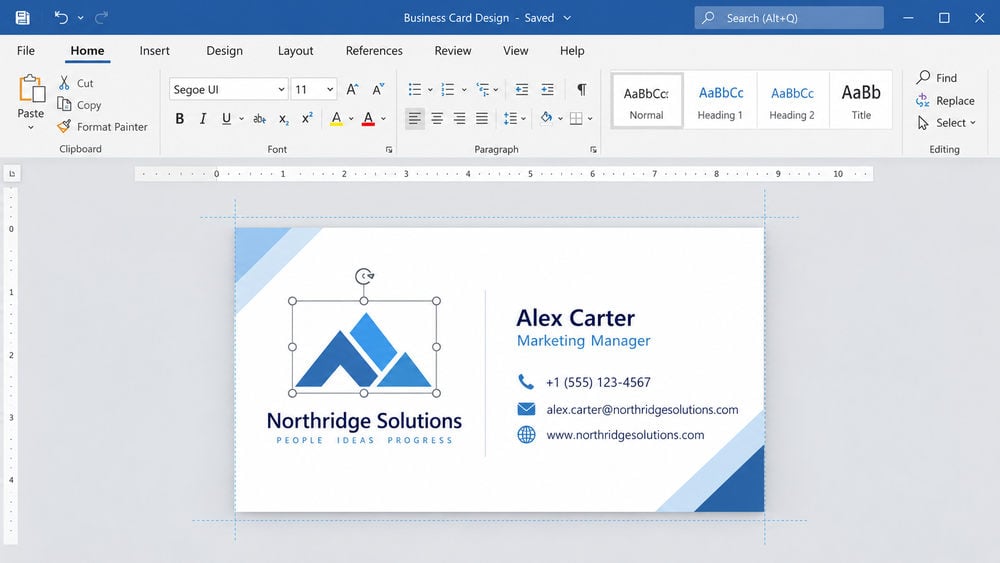
Now that your text and logo are in place, you can add some personality to your business card.
Microsoft Word offers several basic design tools that can help you create a clean and professional layout.
Changing text colours
Highlight the text you want to edit, then use Home > Font Colour to choose a colour that matches your brand.
Adding shapes
Click Insert > Shapes.
Choose a rectangle, line or another shape.
Draw the shape onto your business card.
Use the Shape Format tab to change its fill colour, outline or appearance.
Shapes work well for creating coloured panels, separating sections or adding subtle design details.
Adding a coloured background
One approach is to insert a rectangle that covers your entire design area, apply your chosen fill colour and position it behind the other elements using Send to Back.
If you’re using a full-colour background, extend it into the bleed area so it continues beyond the final trim line.
Be aware that colours may look slightly different when printed compared with how they appear on your screen.
Design tip: Keep your colour scheme simple. Two or three complementary colours are usually enough to create an attractive business card without making it look cluttered.
A good business card isn’t just about the information you include. How you arrange that information matters just as much.
Before moving on, check that:
Your name or business name stands out.
Your contact information is easy to read.
Your logo doesn’t overpower the other content.
The text and images are properly aligned.
Important details aren’t positioned too close to the edges.
As a general guide, try to keep text and logos at least 3mm inside the final trimmed edge, or further if your printer recommends it.
For a 91mm × 61mm document containing 3mm bleed, the final trim line is 3mm in from each edge. Your important information should sit safely inside that trim line.
Leaving some empty space is also a good thing. It helps your design feel balanced rather than crowded.
Once you’ve finished designing your business card, you’ll need to save it in a format suitable for printing.
Although you should keep an editable Word version, a PDF is generally a better choice for sharing your finished artwork.
A PDF helps preserve the layout of your text, images and other design elements.
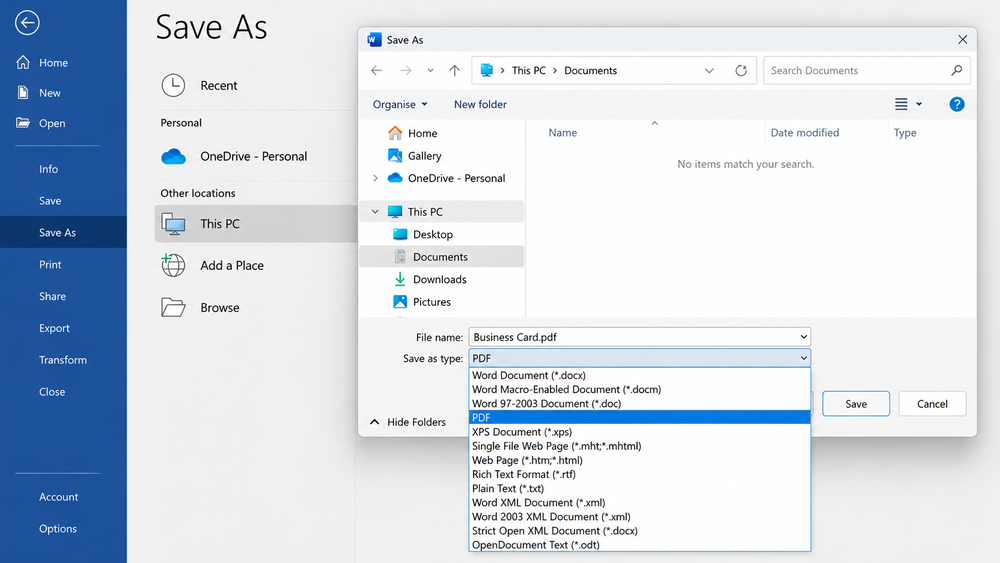
To save your business card as a PDF:
Click File > Save As or File > Export, depending on your version of Word.
Choose where you’d like to save the file.
Enter a suitable file name.
Select PDF as the file type.
Choose the standard or print-quality option if available.
Click Save or Publish.
Open the PDF afterwards and check everything carefully.
Make sure the text is correctly positioned, your logo is sharp and no elements have moved during the export process.
Also check that the PDF page dimensions are correct. Word is useful for basic business card designs, but it doesn’t offer the same professional print preparation controls as dedicated graphic design software. If your printer requires a particular PDF standard, crop marks or a CMYK colour profile, additional preparation may be needed.
Creating a business card is relatively simple, but a few small design decisions can make a big difference to the finished result.
Keep your design simple. Avoid filling every available space with text, images and graphics. A clean layout makes your business card easier to read and more professional.
Choose readable fonts. Decorative fonts can look attractive, but they aren’t always suitable for small printed materials. Use a clear font and create contrast between headings and contact details.
Use high-quality images. Low-resolution logos and graphics can appear blurry when printed. For images intended to print at their placed size, 300dpi is a useful general target.
Check your contact details. Double-check telephone numbers, email addresses, website links and spelling before sending your artwork to print.
Think about both sides. If you’re creating double-sided business cards, consider putting your logo and business name on the front and your contact details on the reverse. Keep the design consistent across both sides.
Choose suitable printing materials. The thickness, texture and finish of your business cards can influence how customers perceive your brand. Even a simple Word design can look impressive when printed on quality card.
Learning how to create business cards in Microsoft Word is a straightforward way to produce your own personalised design without investing in expensive design software.
Whether you start with a ready-made template or create your layout from scratch, the important thing is to keep your design clear, professional and consistent with your brand.
Before printing, check your contact details, confirm the correct dimensions and save your finished design as a high-quality PDF.
Once your artwork is ready, why not bring your design to life with professional printing?
At Cheap as Prints, you can browse our fantastic range of business cards, with a variety of materials, sizes and finishes to suit your business and budget.
From affordable everyday cards to premium laminated options, we’ll help you turn your Microsoft Word design into professional business cards that make a great first impression.
We use cookies to enhance your experience. By continuing, you agree to our Privacy Policy.
Select which cookies you want to allow:
Save 5% on your order when you subsribe to our newsletter.
